Reference basis
Curated clinical guidance, localization methods, device resources and safety references support the tools. Adaptations are identified within each tool.
Sources and guidance → CTDS
Purpose, development and evaluation
A connected workspace for clinician-led TMS assessment, placement and follow-up.
CTDS brings assessment, scalp localization, motor threshold recording, coil setup and outcome tracking into one workflow. It helps clinicians organize information, review reference-based options and document decisions throughout a treatment course.
For trained clinicians working within their professional scope and local governance. Use the full pathway or an individual tool for assessment, placement support, recording and follow-up. Confirm outputs against patient findings, original sources and device instructions before use in care.
Clinician-operated decision support. Not intended for patient self-treatment.
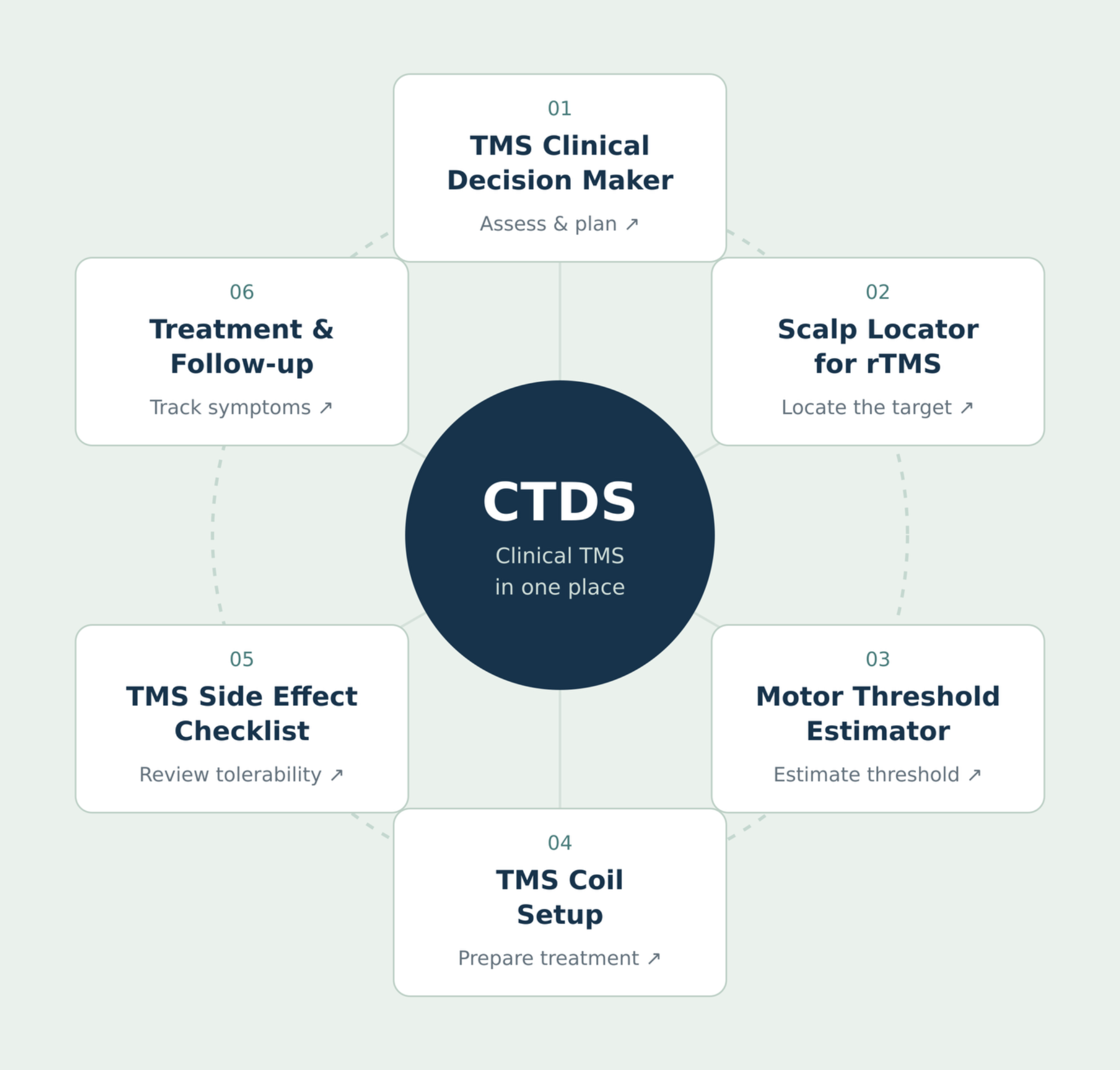
Use the tools sequentially or independently. Adapt the sequence to the patient and protocol; earlier steps are not required to open a tool.
Device-specific pathways may proceed directly from assessment to motor threshold. Neuronavigation and manufacturer instructions take precedence where applicable.
Explore the tools →Reference sources, software testing and clinician feedback inform different aspects of CTDS.
Curated clinical guidance, localization methods, device resources and safety references support the tools. Adaptations are identified within each tool.
Sources and guidance →ML-PEST CTDS has undergone synthetic testing. The linked report provides methods, results and limitations.
ML-PEST simulation study →CTDS has not been validated as a clinical decision rule. Independent clinical validation of ML-PEST CTDS is pending. Clinicians must independently verify outputs before treatment.
Three psychiatrists who use rTMS clinically reviewed workflow and clarity.
Reviewers’ rTMS experience spans clinical practice, observation and patient referral.
Bar widths show the distribution within each section; numbers are individual item ratings. The same three reviewers contributed throughout, so these are not independent participant counts. No strongly-disagree responses were recorded. Preliminary usability feedback does not establish clinical validation.
Responsible clinical use
Clinical judgment, informed consent and device-specific procedures guide every stage.
Automated history highlights may be incomplete. CTDS does not diagnose, prescribe, control a stimulator or provide clearance to treat. A completed form or green result does not establish safety or accuracy. Independently confirm MT estimates before treatment.
The treating clinician remains responsible for the indication, risk–benefit assessment, informed consent, protocol and final decision. Reports support documentation and physician review.
Evidence strength varies by indication and method. Software adaptations and synthetic testing do not establish clinical effectiveness, regulatory clearance or equivalence to another application.
Consult original sources and current device labeling. Reference inclusion does not imply endorsement by authors, manufacturers or professional organisations.
Screening is not clearance. A negative screen or empty flag list does not establish eligibility. Complete patient-specific TMS screening, including relevant implants, seizure history, medical conditions, medications, substance use and changes since the last assessment. Resolve concerns before proceeding.
Follow device-specific instructions, appropriate hearing protection, trained supervision and your service’s monitoring and emergency procedures. Review new symptoms, adverse effects or changes in clinical state before continuing.
Do not rely on a screening score or automated flag alone to exclude risk or manage an urgent concern. Use the appropriate clinical assessment and local escalation pathway.
TMS safety reference: Rossi et al. (2021) ↗Draft entries are held temporarily in this browser tab. Avoid patient identifiers, copy or export any report you need to retain, and clear the assessment when finished.
Earlier entries remain available while moving between tools in the same tab. Review them before reuse. CTDS does not replace your clinical record.
Clinician workflow review
No sign-in, subscription or payment is needed. Use the supplied fictional cases only; do not enter identifiable patient information.
Entries are temporary and are not saved to an account. Export what you need before closing the tab. This exercise evaluates workflow and software output; it is not treatment clearance.